The title may be misleading, as we will cover in general those churches of Byzantine influence, but not necessarily built during Byzantine reign. In some cases, Nessebar was in Byzantine hands, in others in Bulgarian hands, while in others it was under Bulgarian kings, but in a Byzantine yoke etc.
We start with the following diagram showing the main old churches of Nessebar, with the corresponding plans and political regimes.
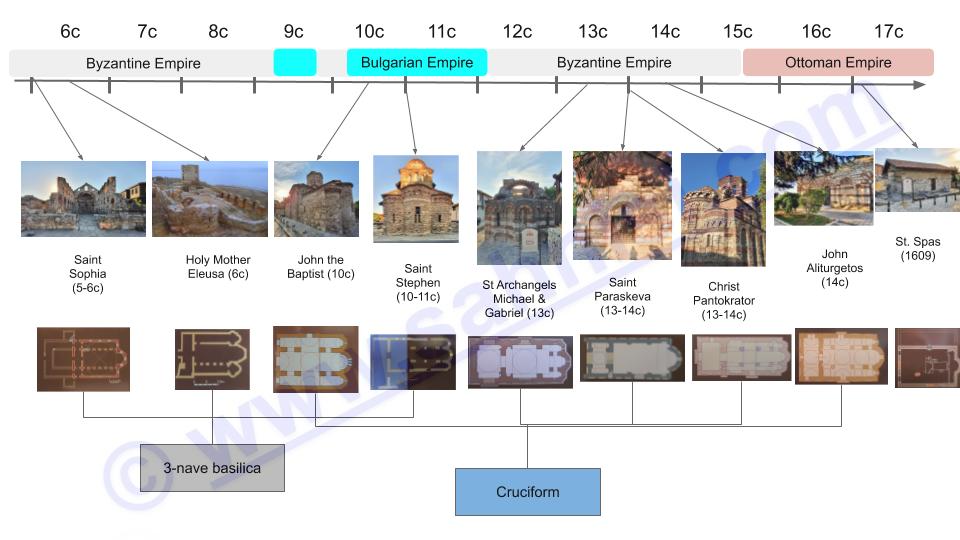
This diagram shows the important transition from 3-aisle basilica to the cruciform shape, around 10th century. It is to be noted that by that time, the Byzantine architecture had introduced the cruciform shape as early as the 4th century in the Church of Holy Apostles of Constantinopole (now destroyed) and that did spread across the Byzantine Empire influencing the plans of some later churches. Interesting to note is the elongation of the plan, caused by the addition of the narthex to the naos. While the naos itself had balanced proportions (see Church of John the Baptist), the narthex simply added to the length of a more elongated plan. Even so, one can see that the overall plan of narthex and naos slowly recaptures its square shape towards 14c (John the Aliturgetos). Finally, during the Ottoman years, it is believed that Christians were prohibited from building impressive churches and were constrained to build up to the height of a riding horseman. The number of built churches considerably decreases and the ones that resisted in our days are far less impressive in dimensions and decorations (e.g. St. Spas).
But what draws attention and makes these churches unique are the decorations of these churches, especially during the glorious period of 13-14c, where the town flourished and correspondigly, churches with lavish decorations were built in the typical Slavo-Bulgarian style. That is explained in Part II.
All these churches are shown on the map of Byzantine monuments.
 sahnisi