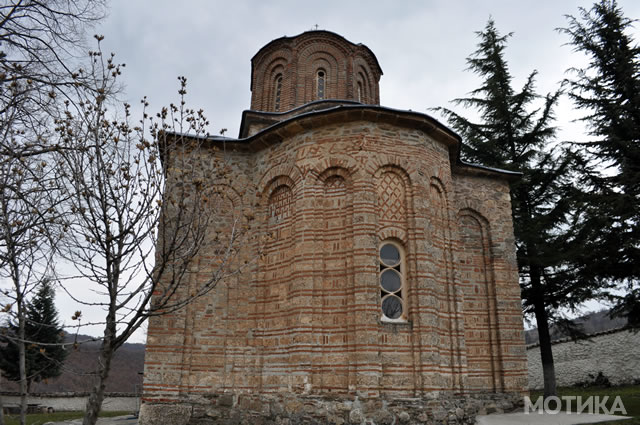
Previous post covered the list of main churches in Nessebar, along with the transformation of their plan from 3-aisle to cruciform. But the beauty of these churches lies in the lavish unique decorations, especially of those built during the 13th and the 14th centuries, during the Second Golden Age of Bulgarian Culture, during the Second Bulgarian Empire. There are common motifs and building methods that hint towards the same workers who participated in the building process. These monuments are very good examples of the Artistic School of Tarnovo from the Bulgarian Second Empire, what we will henceforth call as the Tarnovo style.
There are four churches to study as part of this group. First church is the Church of Saint Archangels Michael and Gabriel (#BYZ28). While not in a good shape, partly destroyed, the church facade is renovated and is still enough to capture the beauty of the ornaments.
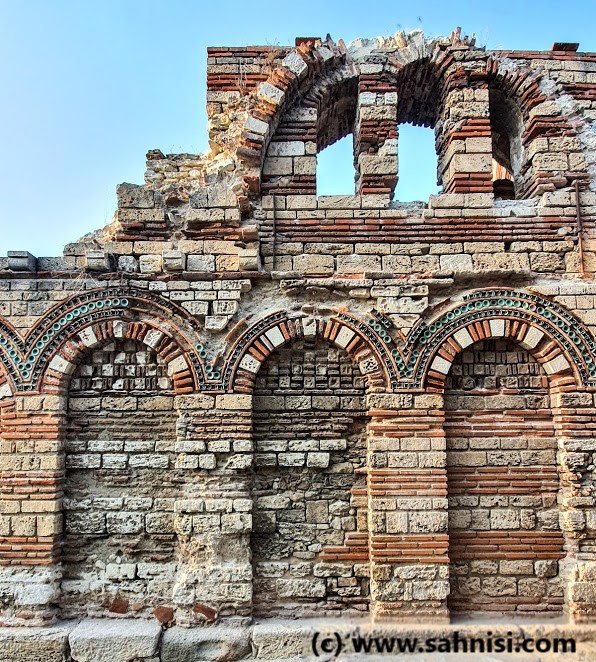

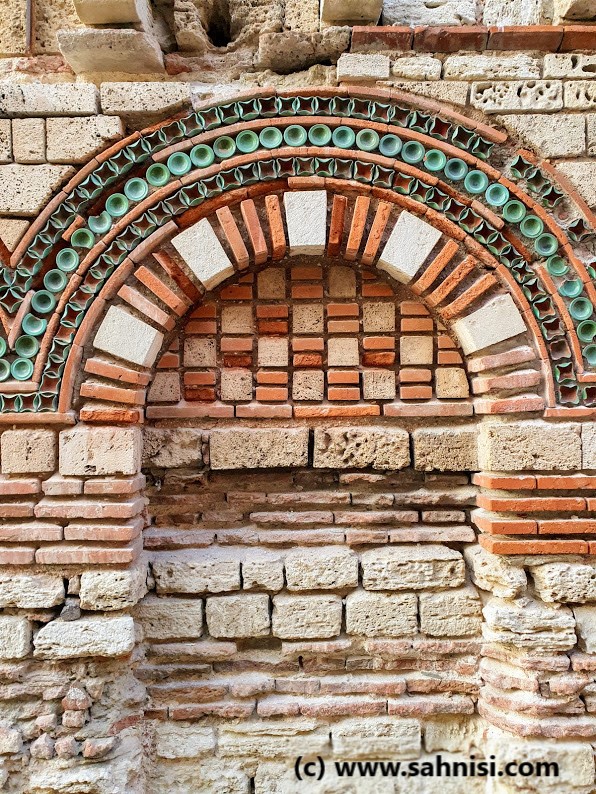
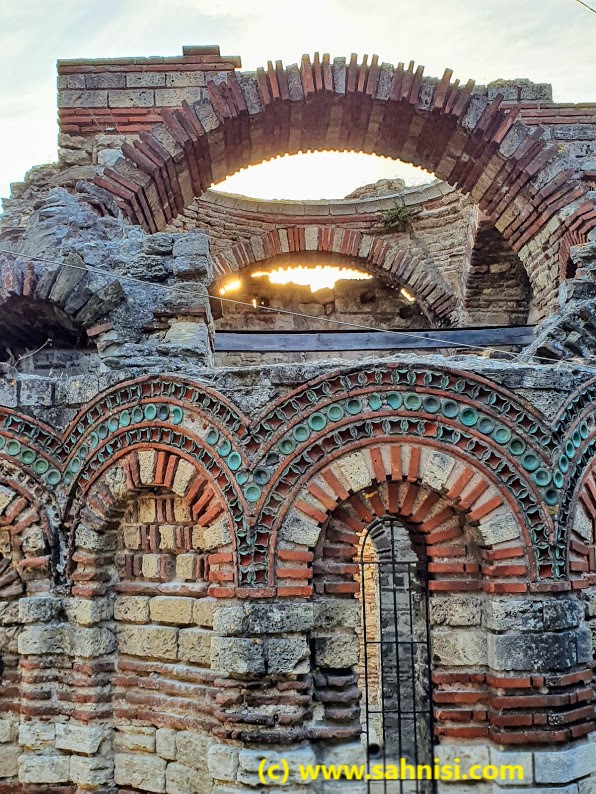
Southern facade and close-ups of the checkerboard pattern (1, 2, 3) and the eastern apse (4) of the Church of St. Archangels
The brick work is somewhat typical for the Early Byzantine days, with an opus mixtum technique with thick limestone bricks, coarsely cut in rectangular shapes, alternating with red brick lines. This creates a nice continuity of the texture and an elegance of the foundation. If one raises the eyes, will notice on the southern facade large semicircular niches delimited by blind arches, sustained on pilasters. There also is a small opening on the eastern side on one of the arcades of central apse (one of three apses on that side). The arcade headings are decorated in checkerboard pattern. The dark squares of the checkerboard are created with two thin brick lines, whose position alternates from vertical to horizontal from one arcade to another. This is the same pattern that can be found in the Church of Saint Nikita in North Macedonia, an influence that will be explained in a later post. The arcades are then surrounded with three rounds of concentric curvilinear frames of colored ceramique. Each one of the three layers consists of repetitive motifs in the order X, O, X. The effect is quite pleasing to the viewer. The opus mixtum alternance as well as the X, O motifs alternance creates harmonious horizontal registers that attenuate the massivity of the monument. On top of naos used to stand a dome, supported by 4 semi-cilindrical vaults, collapsed in the meantime.
We are moving on to Church of Saint Paraskeva (#BYZ36). While (still) not fully restored, at least it is rennovated and can be visited, even hosting an art gallery. The roof has been lost, as it is now a two-sloped roof, whereas it used to have two domes, one on top of the narthex and a bigger one, on top of the naos. Of these two, the visitor will only be rewarded with the former dome, which is pretty impressive to analyze nonetheless. First of all, the dome is not supported by pendentives. Instead, a small adapter form, called trompe d’angle, is used to adapt the circular dome to a square. Four such trompes are used in each corner of the square. Then four big arches support the dome. Whereas by usign a pendentive, the size of the arches is dictated by the size of the dome itself (rather small), by employing such a technique the builder is able to widen the area and the size of the arches. But that is only half of the story unfurled by this petite dome. The two arches (northern and southern) are supported by two wooden beams. They are decorated with vegetable motifs that most likely date back in the Ottoman period, some centuries after the church was built. The style of painting ressembles the Mughal calico patterns or the Tokat style printing style, established in the Ottoman decorations throughout the entire existence of the Ottoman Empire, bearing influences from the Middle East and from India. Last but not least, one should notice the minimalist cross at the tip of the dome.
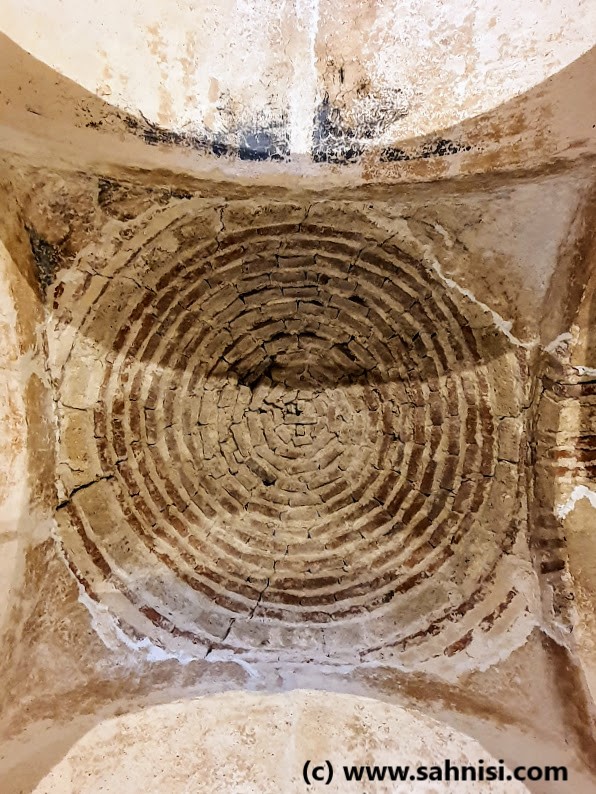
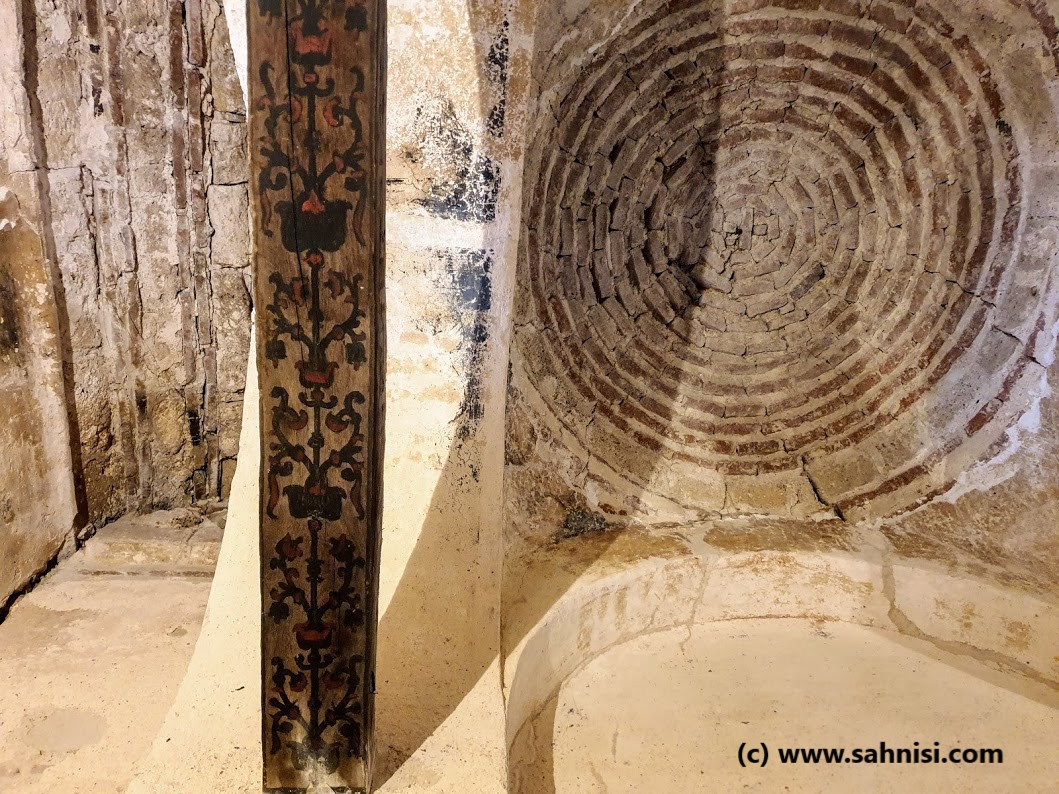
The dome with its four ”trompes d’angle” (left) and the wooden beams decorated with rich painted ornaments (right).
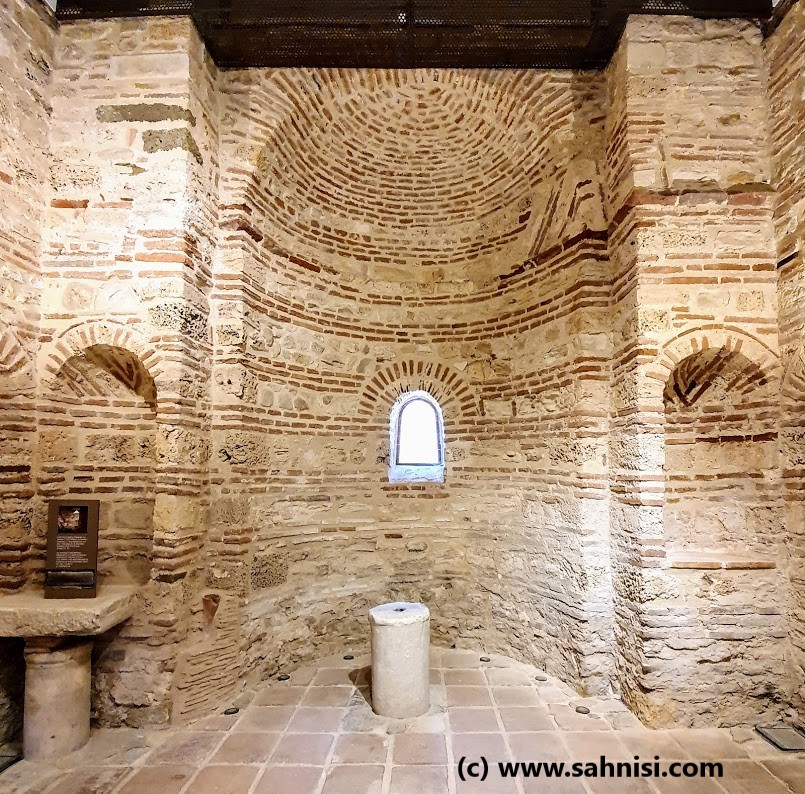
Inside Saint Paraskeva, there are beautifully carved pastophoria niches, mainly the diakonikon to the right and the prosthesis to the left. These niches or apses are typical to the Orthodox altars. The diakonikon hosts the books and priest’s clothes, while the prosthesis hosts the sacred vessels. The opus mixtum brick layering is seen on the inside as well, though we should probably assume that the inside of the church was painted in the beginnings.
On the outside, Church of Saint Paraskeva follows the same patterns of the St. Archangels Church, as it can be seen from a picture of the west-side entrance. The entrance is marked by 3 arches, with the central one being both wider and higher and containing two openings: the door and a small window. The arcades are beautifully embellished by the same three rows of colored ceramic rosettes, following the same alternance patterns of X, O, X, here colored in a very diverse palette, from green to red and turqoise. The X-shaped rosettes are actually four-leave motifs that look like X from afar. The voussoirs of the blind arches do not have checker board patterns this time and they follow some alternating oblique motifs. Same patterns can be found on the east-side facade, hosting the altar apse. But the apse features blind arcades, just like the previously described church. In the headers of these arcades, there are different symbols, such as a sun or the four circles which could call to an astral theme as well.
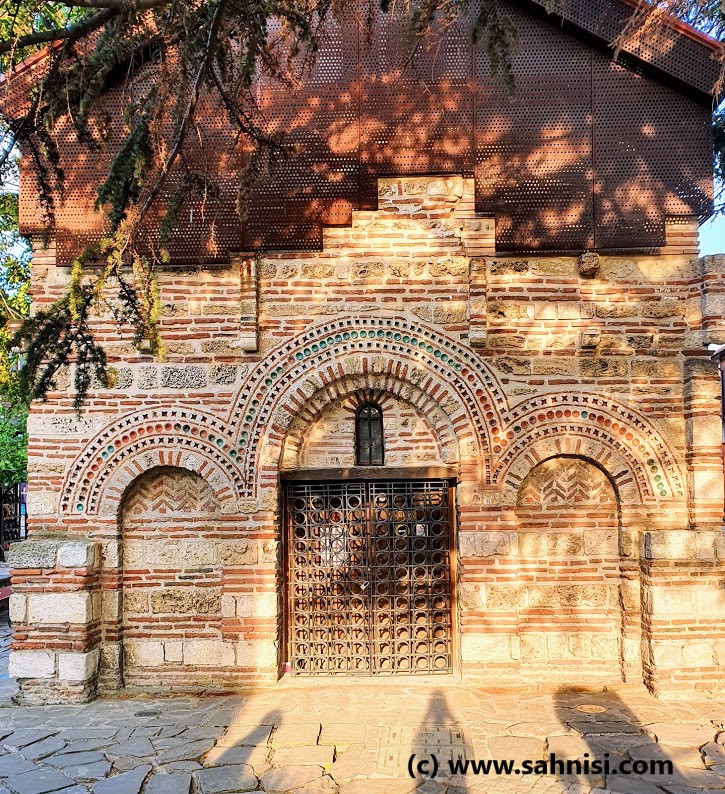
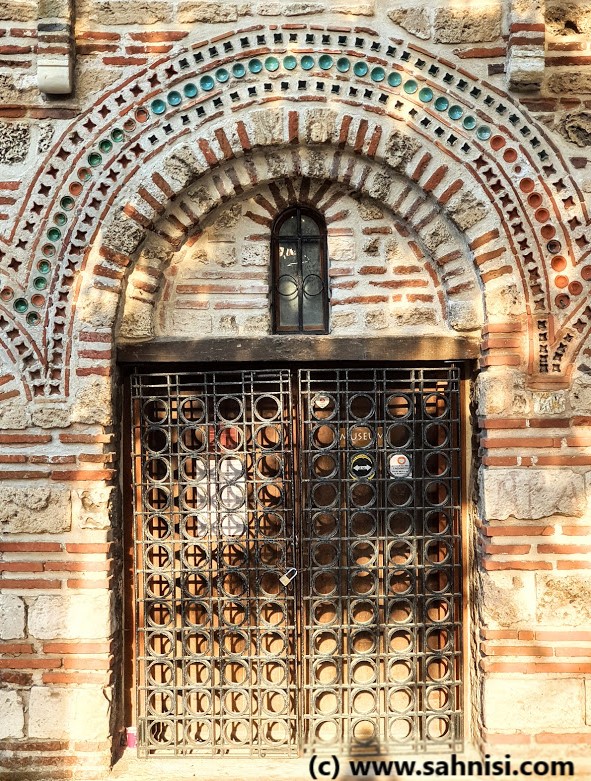

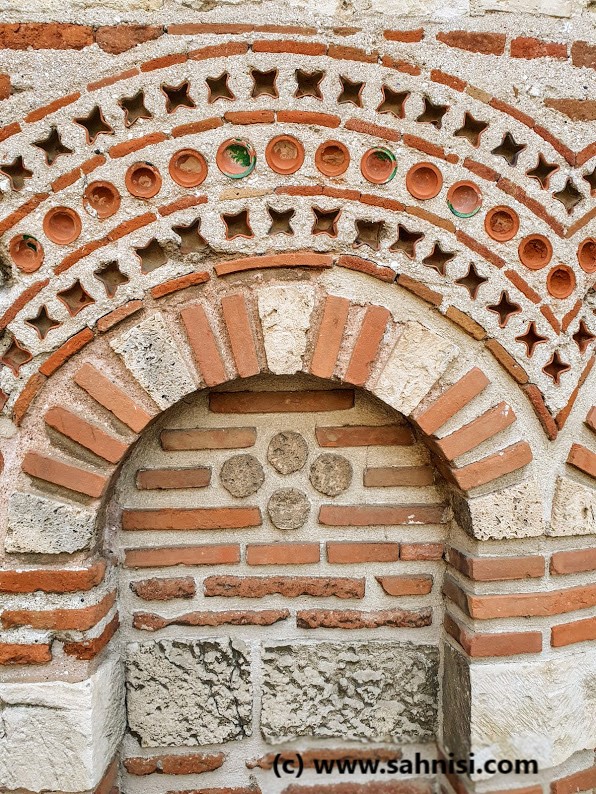
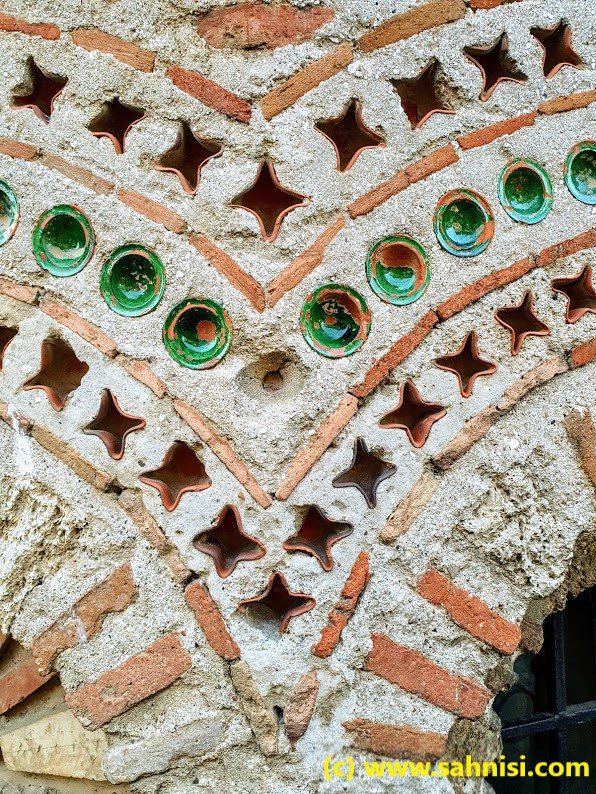
West-side facade of the St. Paraskeva Church (top left) and a close-up (top middle). Top right image depicts the eastern apse. Bottom-left: the stars motif, bottom-right: detail of the ceramic rosettes.
The two remaining churches are exquisite for a pattern tracking exercise. First we go to Church of Christ Pantokrator (#BYZ27), right at the city entrance. It is a shame that the church is not open for public visits (as of July-2020). We can still admire the church from outside. We are probably looking at the most beautiful church in Nessebar, with the richest ornaments and one with quite an ellaborated plan.
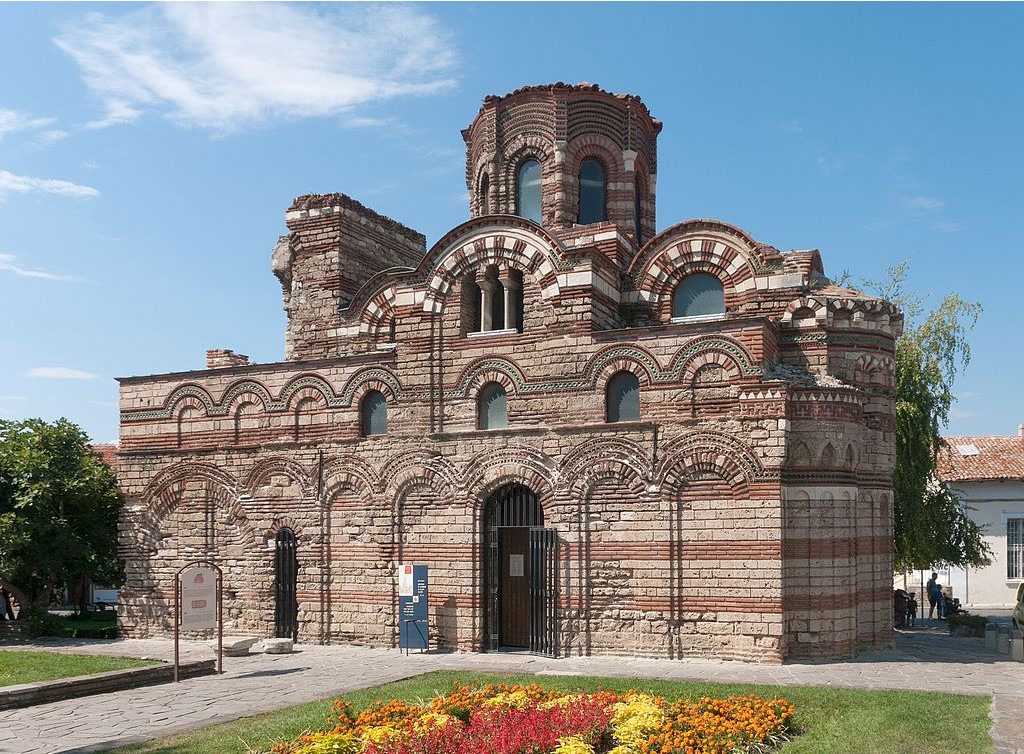
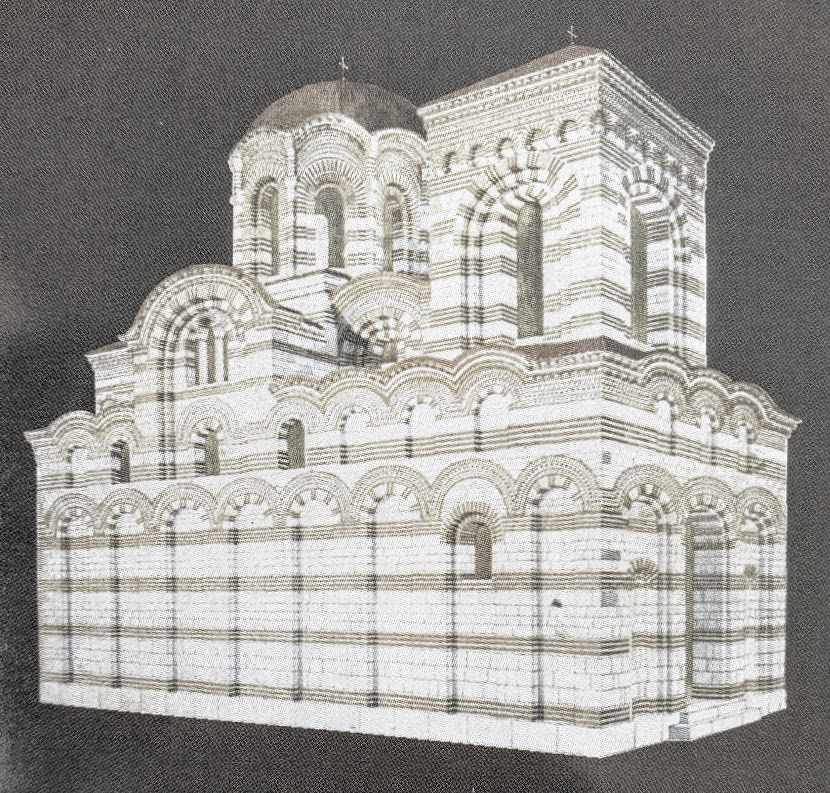
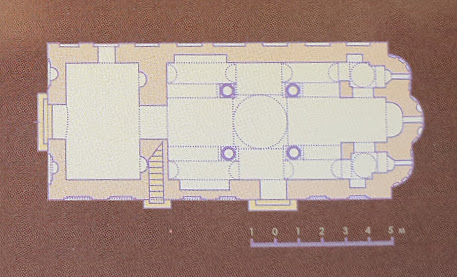
Left – The south view of the Christ the Pantokrator Church (from [3]). Top-right – 3D modelled north view with a reconstructed bell tower above the narthex (from [1]). Bottom-right – The plan of the church (from [1])
The narthex had a bell tower, a belfry, that collapsed and has not been reconstructed. It is unclear whether there is any intention to reconstruct it, as the church has just recently been restored. The naos has a cruciform shape, cross in square, with the dome having octogonal shape on the outside and spherical shape on the inside. The dome is supported, just like in the case of St. Paraskeva, by a tambour and then by the aid of four trompes d’angle placed in the corners, it is transformed in a square shape, which sits on top of four arcades. The arcades evolve in four semi-cilindrical vaults which extend to the four cardinal points. The north and south vaults end with two large semi-cilindrical arcades, each one featuring an opening sustained by two columns. The eastern arcade ends in a semi-spherical apse.
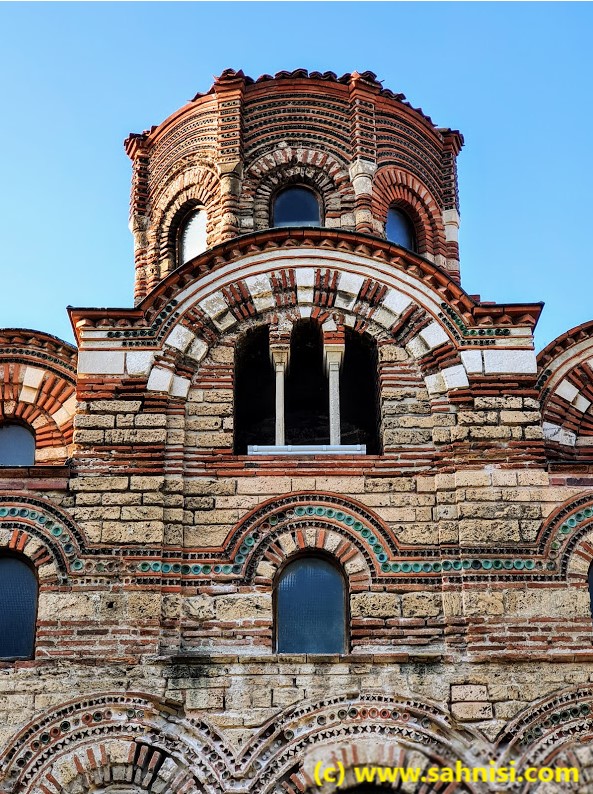
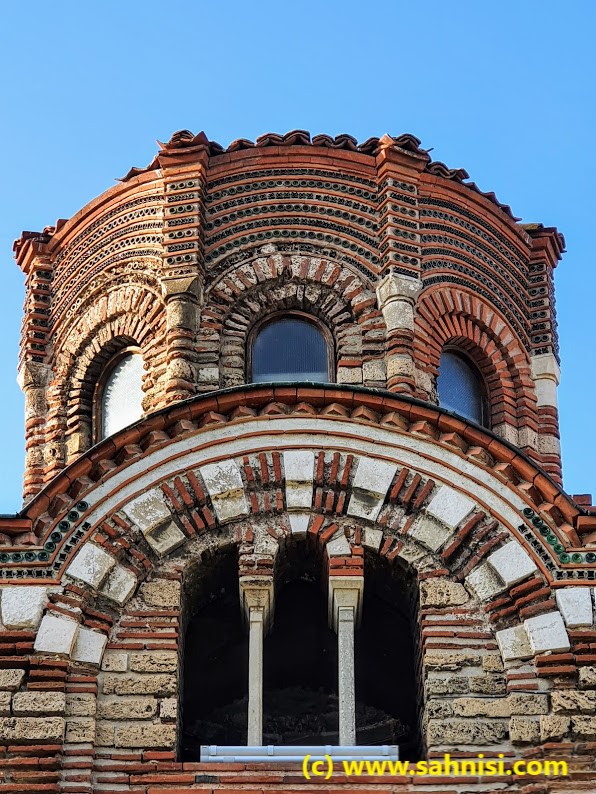
South view of the octogonal dome and of the semicilindrical vault sustaining it. The vault ends with a large arcade featuring an opening sustained by two columns.
In terms of ornaments, the dome is densely decorated. There are four semicircular windows, separated, at the octogon’s corners by square pilasters, with simple pyramid capitals. The windows are framed not by three, but by 7 layers of X, O alternating ceramic rosettes. The motifs continue along the pilasters with the same rhythm. The brick work is opus mixtum, continuing across pilasters as well. The south and north large arcades are covered by two layers of alternating bricks. The alternating bricks are the massive white-ish limestone and three thin red bricks. Then come two concentrical layers of ceramic rosettes with circular forms. Then the last pattern is the sawtooth pattern which is one of the most common motifs that radiated throughout the Orthodox Balkan churches.
Continuing on the northern and southern walls, we see that in fact there are three horizontal registers, with the large arcades described above being only the top register. But if we go down (and this is how I was compelled to look at the building, from top to the bottom), we discover the middle register consisting of a series of semicircular arcades, most of them blind, with the exception of the ones below the large top arcade. The bottom register is the tallest one and it consists of elongated blind arcades, with one opening at the narthex. Also, this bottom registers protrudes to cover the wider surface of the plan. Thus, incrementing rectraction of the above registers confers the feeling of an elegant monumentalism. Each one of the arcades is framed by the ceramic rosettes, placed in 2 or 3 layers. Lastly, the entire church sits on a layer of stones, half a meter thick.
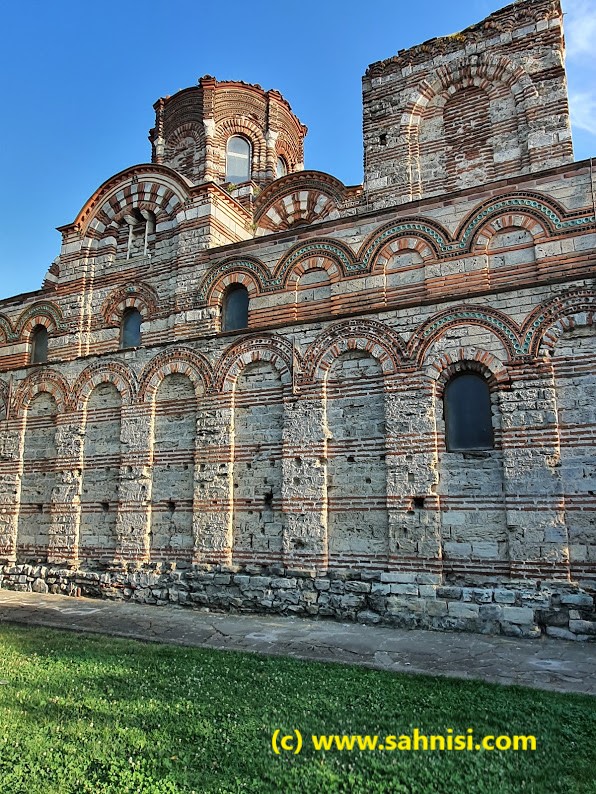
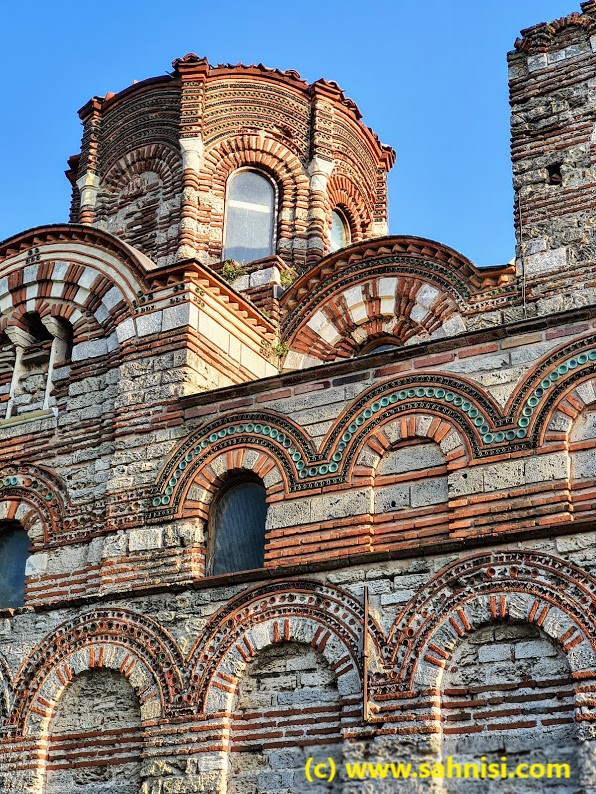

Left – view of the entire north wall with the three horizontal registers: the top large arcade, the middle arcades (some blind) and the tall bottom register. The secondary large top arcades between the dome and the bell tower can be seen. Middle – close-up of the three registers. Right – close-up on ornaments.
It is worth noticing (how could anyone ignore it?) that on each side of the top large arcade there is one equally large and identically decorated arcade with no apparent supporting role, other than to create an intricated structure of forms. Indeed, as seen in the above picture, without this secondary large arcade, there would be a void space between the dome and the bell tower, as seen from the ground. This second round of arcades fill this void, but they are set back, in line with the bell tower and do not steal the show from the main facade, rather they create continuity between the narthex and the naos. In fact, as it will be seen later, these arcades have some functional role and they support two smaller almost imperceptible spherical domes flanking the main taller octogonal dome.
The Western side hosts one of the two entrances (the other being on the south). As it is the case with the others, it features the bottom tall arcades (three) and the middle smaller arcades, embellished by the ceramic rosettes. The top register in this case is the belfry, now destroyed, who was a square-shaped tower with semicircular openings on each side, hosting the bell in the center. To break the monotony, the three high arcades at the bottom register are organized as follows. The central one has the entrance door, which is flanked by two other arcades, each one featuring a semicircular niche, as if it relays the image of the altar with the two apses. Also, a very nice effect is created by the middle register. Instead of adding two more arcades, at each side of the wall, the builder broke the pattern by leaving the horizontal ornament line simply following the horizontal trend.
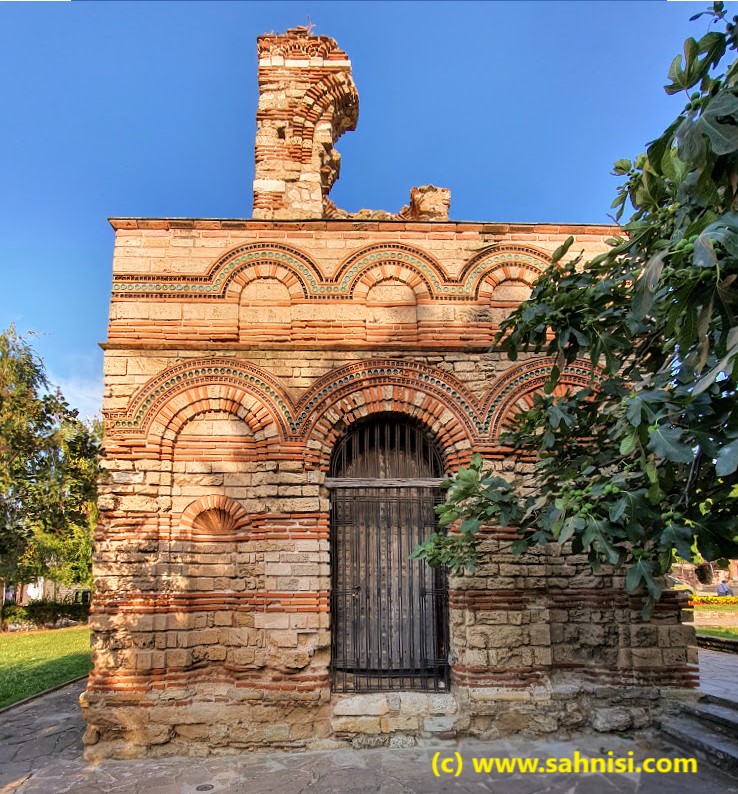
The south view is breathtaking. The altar ends in three apses, one larger, the altar and two smaller, the pastophoria.
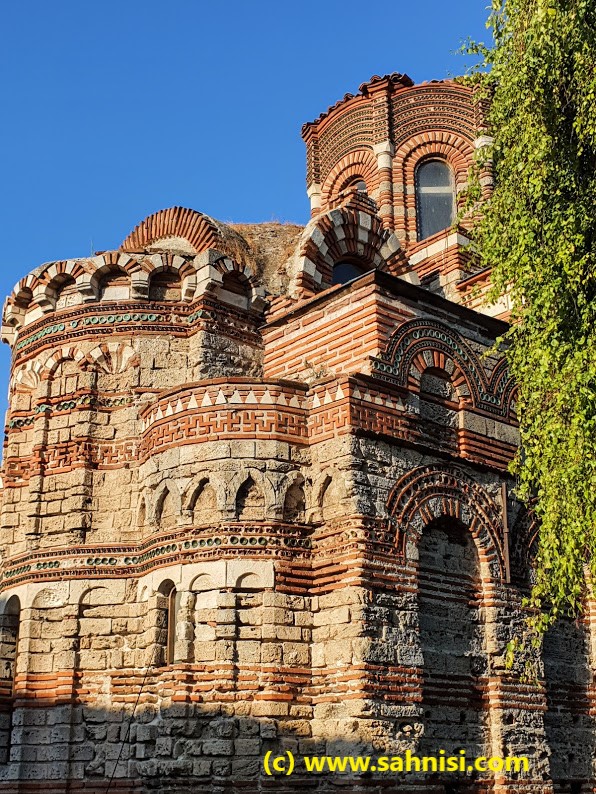
The apses also feature horizontal registers, though not perfectly in line with those of the east-side and west-side walls. The first, bottom, horizontal register consists of tall and narrow semi-circular niches and it is continuous across all three apses. The belt of ceramic ornaments (X, O, X) flows smoothly on top of the blind arcades. The arcades of the smaller apses are narrower than those of the central apse. Moreover, the central three arcades of the central apse are basically deeper with a half-spherical shape and the central one has a window. The smaller apses then exhibit a belt of arcades in almost pointy shape, which is not replicated on the central apse. The pointy arcades are covered by alternating left-hand and right-hand swastikas which is not an unusual ornament in the Byzantine vocabulary. Then this is covered, under the roof eave, by a row of alternating upward-downward triangles made in red brisks and white plaster. The main apse also has a second register of arcades, but these are much taller, identical to those on the bottom registers. They are interrupted by the belt of swastikas continuing from the smaller apses and by another belt of ceramic rosettes, continued from the second register of the north-/south- walls. Moving on, they end with beautiful semicircular crowns. The motifs alternate across arcades. There is a third register of the central apse, as this ends with beautiful small protruding arcades.

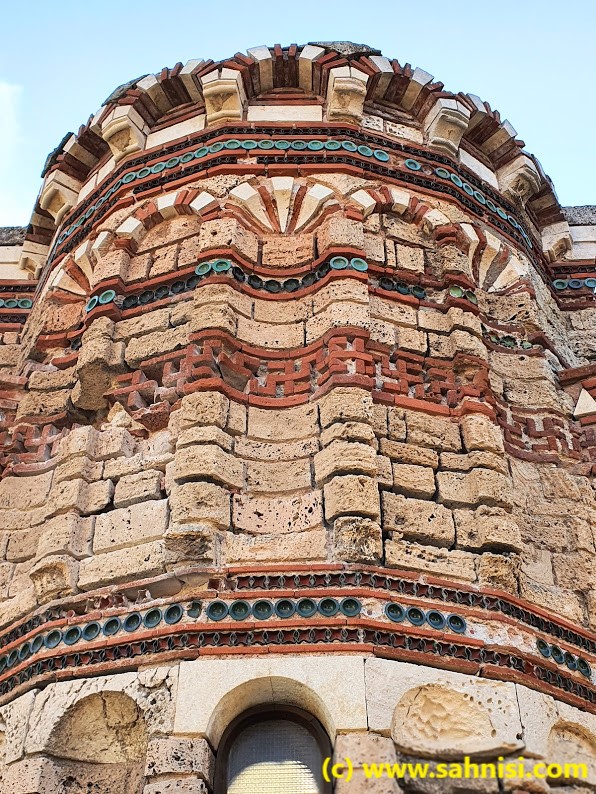
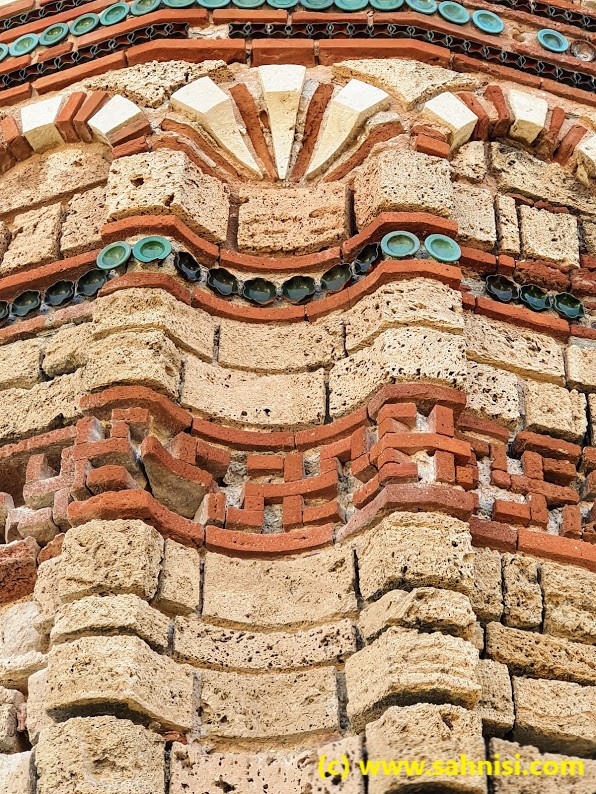
Left – lateral apse (prosthesis) showing the bottom arcades, the pointy arches, the ceramic rosettes, the swastika belt and the traingle belt. Middle – Detail of the middle registers with arcades (some of them semispherical in depth). Right – closeup of swastika and ceramic decorations.
The last church in the list is the Church of John the Unconsacrated (Alitourgetos) (#BYZ38). While the church itself is destroyed, it shows rich ornaments made with bricks or monograms. The decoration is not flamboyant as with the John the Baptist, but the symbolism is much more important. There are so many and diverse symbols, that one would need to spend quite a lot of time analyzing each one of these.

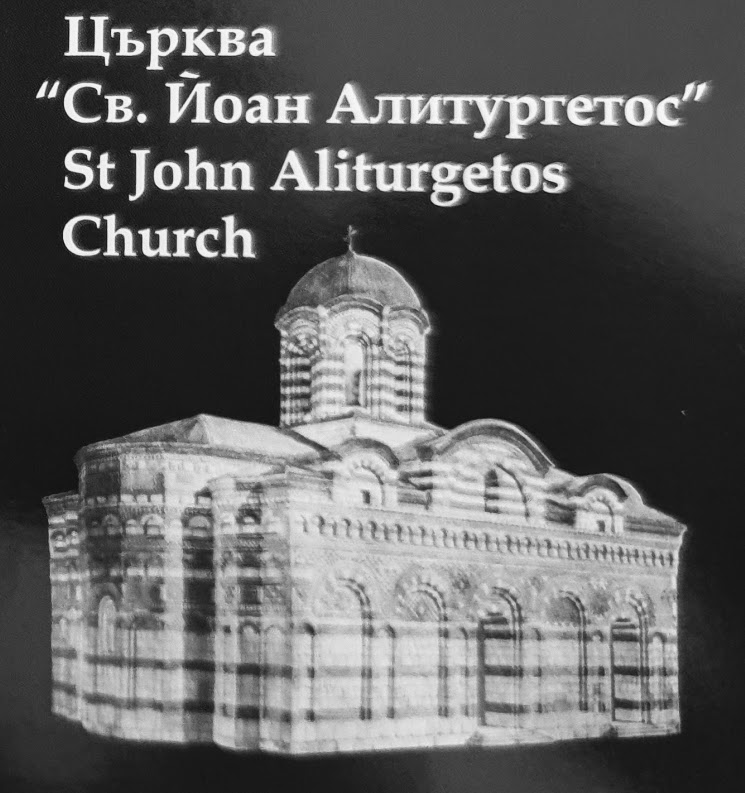

Left – General view of the north wall. Top-right – Image of reconstructed 3D model of the Church of John Alitourgetos (from [1]). Bottom-right – south view of John the Alitourgetos (from [4])
The pediment consists of thick, large stones, on top of which rises the wall in the same opus mixtum manner with layers of limestone bricks and red brick lines. On the northern side there are large semicircular arcades flanked by smaller niches, each one of them, having their headers (the circular section) heavily decorated. In addition, as it is the case with Saint Paraskeva, the shape of the niches seen in depth alternate from flat to semispherical. Spending a bit more time on the headers of each small or large arcade, we can see that each header has a filling pattern and or a symbol that are different from one arcade to another. The arcades are topped with two layers of voussoirs. Between the openings of the arcades there are other diverse patterns and monograms.
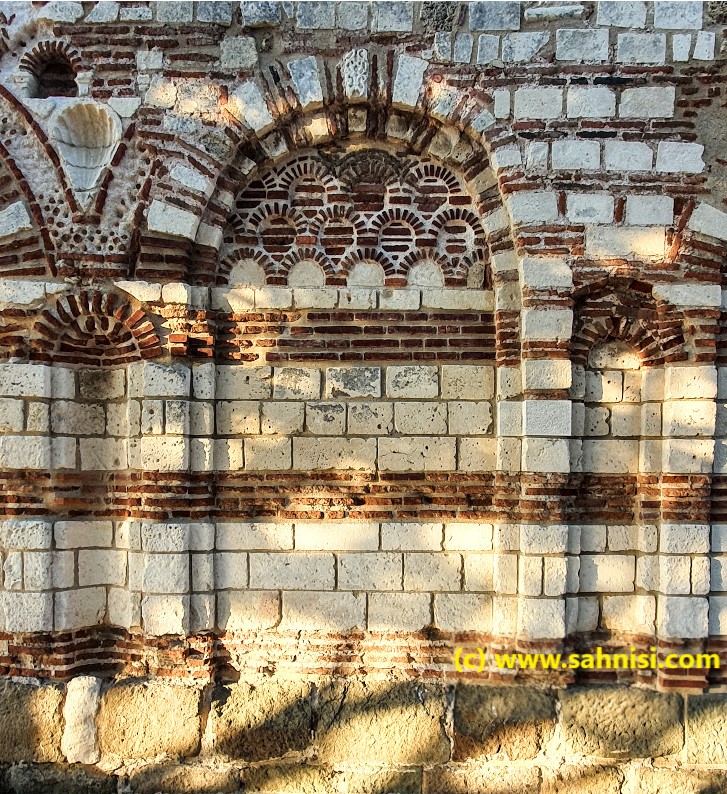
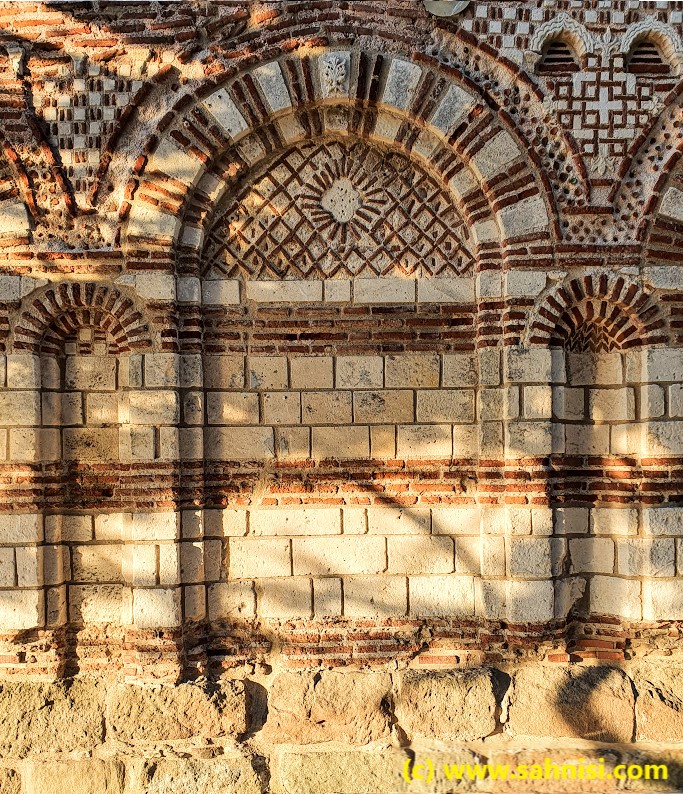
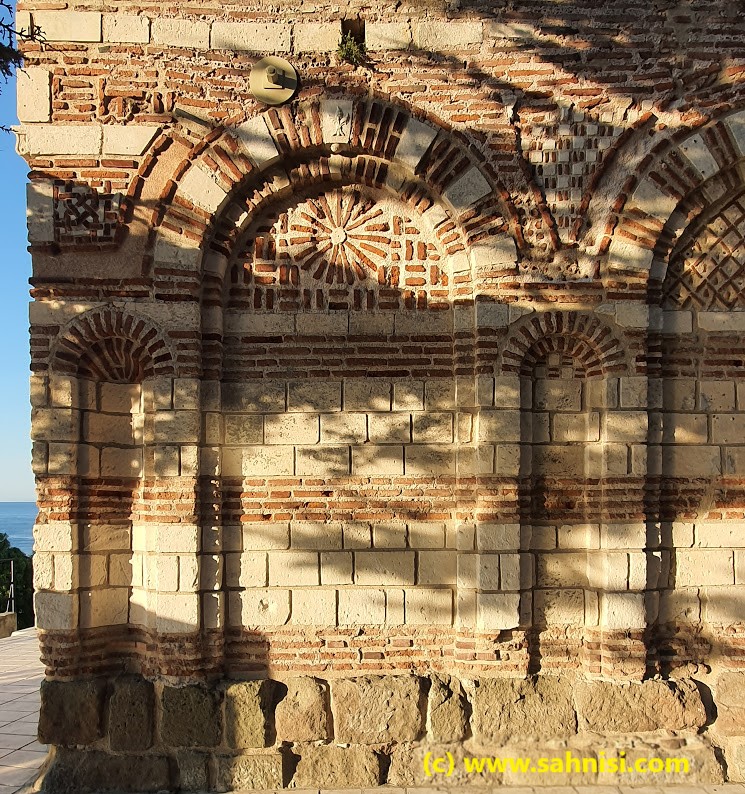
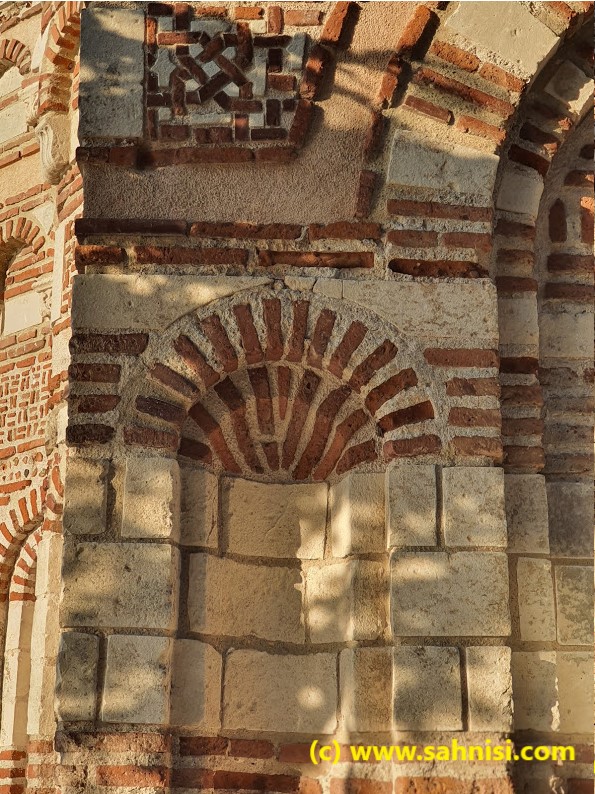
Each large arcade is flat in depth and flanked by two smaller arcades, one semispherical in depth and the other one flat. Both types have multiple concentric voussoirs, consisting of limestone bricks and brick lines. 1 – The large arcade has a sea wave-like pattern. 2 – The large arcade has a quatrefoil symbol of the sun, which is not unusual in the Byzantine world, later widely used in Gothic and Renaissance churches. The diamonds surrounding the sun can call to the rain. The other two smaller arcades have checkerboard patter and a zig-zag pattern. 3 – The large arcade has a radiating sun pattern. Between the large arcades, there are checkerboards or intricated geometrical shapes. 4 – Above the large arcade there is a very nice geometrical motif, almost resembling an Islamic one.
There are various monograms displayed within the patterns, hinting towards ecclesiastical or nature motifs.


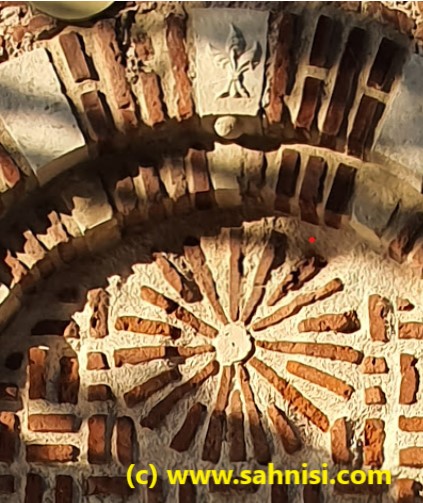
Monograms displayed on the walls of John Alitourgetos. 1 – The shape of a shell, incized in the wall. 2 – The Christian cross with the letters IC XP NI KA, written in Cyrillic letters but read in Greek language as ”Ιησούς Χριστός νικά”, meaning ”Jesus Christ wins” or… less formal translation ”Jesus Christ the Conqueror”. The cross is carved as an intricated pattern of flowing threads, as if it were a golden jewel. 3 – A lilly flower, 4 – Another flower, that is more difficult to identify.
The eastern facade is also rich with such ornaments and monograms, albeit not in a very good shape. Traces of ceramic rosettes can be seen as well, but it is clearly less opulent than in the previously described churches and not so well preserved and restored.
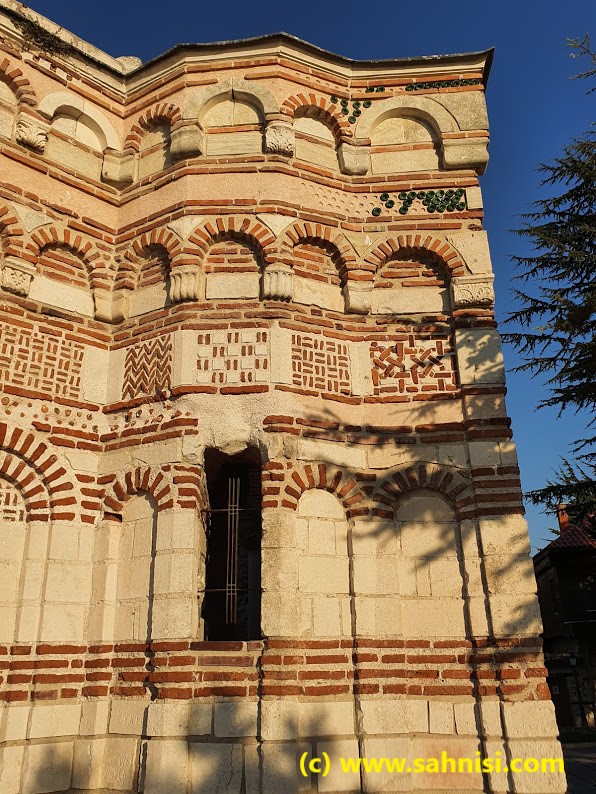
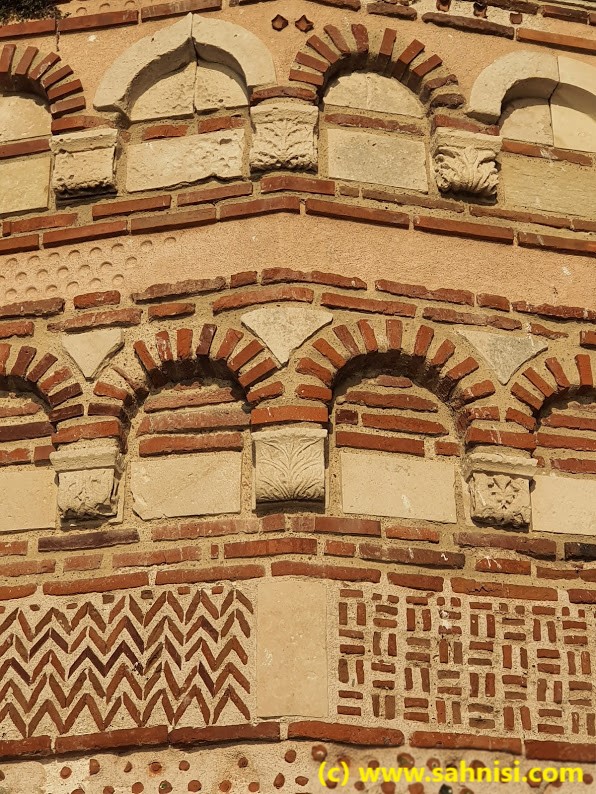
Left – Traces of ceramic rosettes topping layers of arcades, each surrounded by beautiful voussoirs. Checkerboard, zig-zag, intricated Islamic-like patterns. Right – Pointy arcades alternating with the regular type, sculpted corbels with vegetable motifs, showing the tree of life.
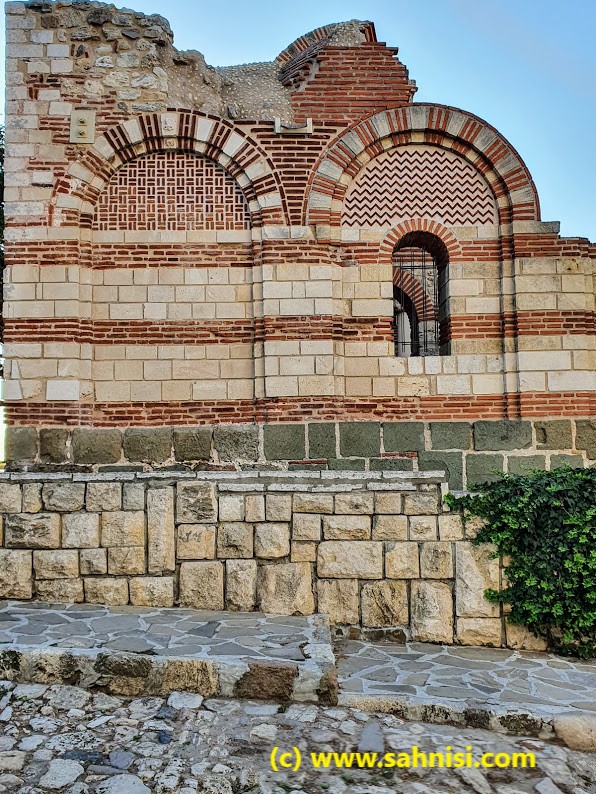
The western facade is less preserved and newer materials are clearly used as part of a partial rennovation. The patterns are still visible.
Bibliography
[1] Ancient Nessebar Museum, Collection Ancient Nessebar, Vol. 5 Churches of Nessebar
[2] Petya Kiyashkina, Nesebar, The Millenia Old Town, Publishing House ”Slavena”, 2007
[3] https://en.wikipedia.org/wiki/Church_of_Christ_Pantocrator,_Nesebar
[4] By MrPanyGoff – Own work, CC BY-SA 3.0, https://commons.wikimedia.org/w/index.php?curid=19784752
 sahnisi